

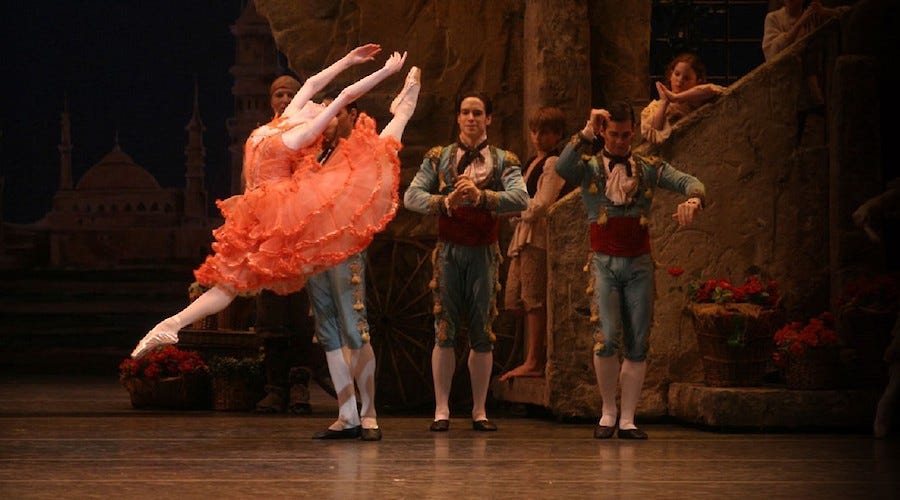
Gillian Murphy in the ballet 'Don Quixote'. Photo: Rosalie O'Connor. Book adaptations, math, and physics what’s not to love about ballet?
Writing about Ice Princess made me think about my own ballet training. I took ballet classes long before I knew math or even could read. My detail-loving and pattern-loving brain gravitates towards ballet over other forms of dance. I never aspired to be a professional dancer, but I still love ballet. I don’t perform; I mainly just do YouTube classes (I highly recommend checking out Katherine Morgan’s channel and Mary Nora’s Substack). I do enjoy the cardio, balance, strength, flexibility, and artistry of ballet, and I never get bored of it.
There is also a lot of math and physics (and French!) in ballet. Ballet requires intense precision and coordination within individuals and the corps. There is also artistry required. Music, facial expressions, hair, makeup, and costumes are meant to depict moods and characters. Entire narratives (e.g., Sleeping Beauty, Swan Lake) are conveyed through music and the dancers’ movements.
In a typical ballet class, students warm up at the barre, doing a combinations of knee bends (pliés), toe points (tendus), foot brushes (dégagés), leg extensions (développés), and calf raises (relevés). At more advanced levels, these basic moves are strung into intricate combinations, which help with flexibility, coordination, balance, and memorization. The second half of ballet class consists of dance combinations in the center of the room, often involving more advanced turns, leaps, balances, and jumps.
It’s interesting that an art form which is heavily geared towards women and connotates femininity, requires such intuitive understanding of math and physics, fields women have historically been excluded from.
Counting
Positions: Ballet positions are numbered as first, second, third, fourth, and fifth positions, each position engaging different muscles in the body to promote turnout. A dancer will typically begin and end a movement starting from one of these positions.
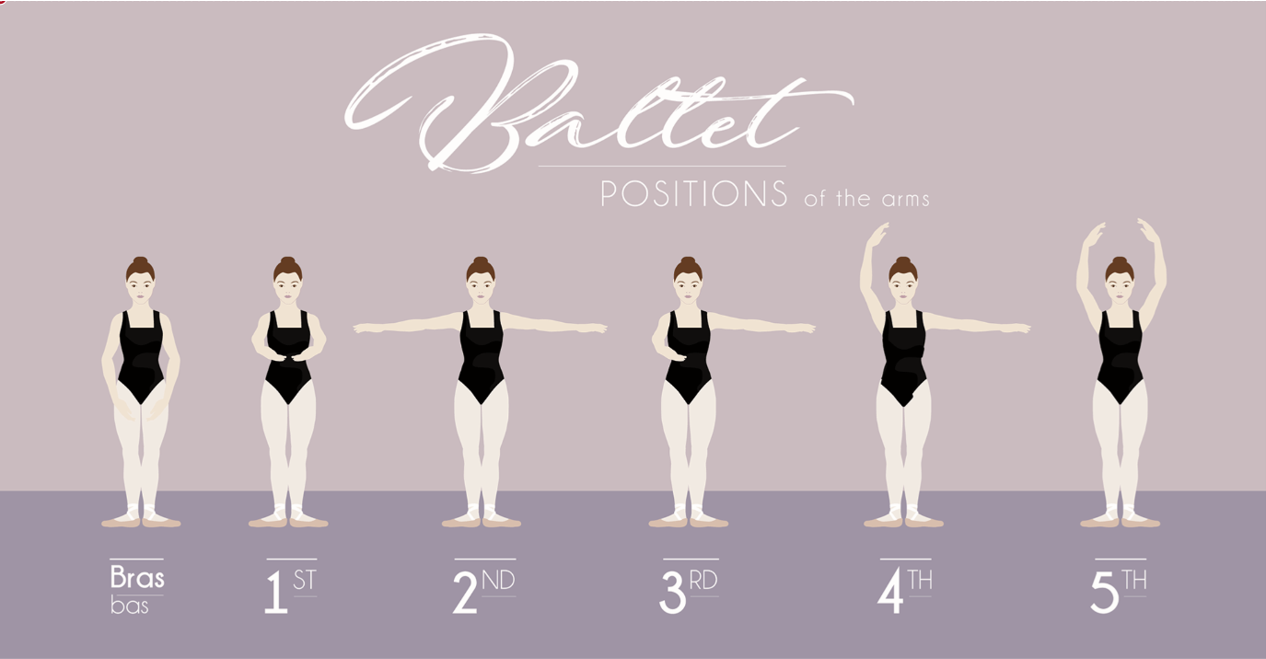
The five positions of ballet require different feet and arm movements.
Music: Music is counted out in groups of eights. This is especially evident in barre, combinations, where dancers warm up. Typically, the combination will fill out eight counts in the music and then be repeated again in the next eight counts. Dancers have to remember the number of times a move needs to be repeated while keeping pace with the music, so they don’t fall behind! Often, the dancer has to repeat the combination using the other leg, which can be tricky!
Movement Patterns: Patterns of movements are developed based on direction (front, side, back, left, right). For many combinations, the dancer will pointe, raise, or brush their foot forward, then to their side, then behind them, then to the side again. This pattern is called en croix, as the dancer is “drawing” a cross out with the shape of their foott. During center combinations, the dancer often angles their body towards different directions of the room to complete intricate choreography. There are specific arm movements which are paired with certain directions of the room.
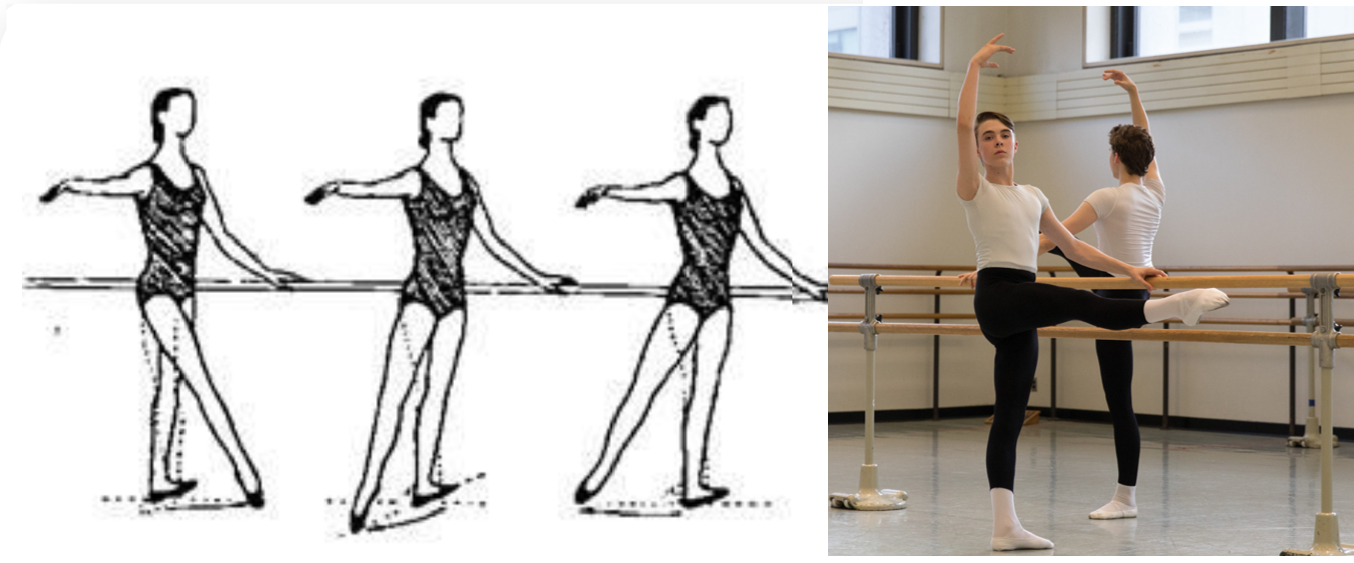
LEFT: The dancer is at the barre pointing their foot front, side, back, in the shape of a cross, which are 2 intersecting, perpendicular lines. RIGHT: The dancer is extending their leg at a 90-degree angle in front of them in a move called développé. During développé, the leg is raised, extended, and lowered in 8 counts of music.
Geometry
Turnout: Turn out is how far the leg can be rotated. As shown in the ballet figure diagram above, the dancer attempts to rotate both of their legs to 180 degrees before beginning the dance combination. Turnout is controversial in the dance world, since it is highly prized for aesthetic reasons, rather than practical reasons. A 180-degree turnout is almost impossible to achieve by many and can put a dangerous strain on dancer’s joints.
Angles & Extensions: Angles are very important in ballet. When a dancer extends their foot, they may be asked to lift it 45 degrees off the floor, or even 90 degrees off the floor. This provides an intuitive understanding of angles. Very advanced dancers can lift their leg, so it is almost 180 degrees off the floor.
Turns: Some combinations require the dancer make complete revolutions with their body (turns) and land in the exact direction they started from (360 degrees). Advanced dancers can make 2 or 3 revolutions.
Leg Shapes: Passé position is forming an equilateral triangle with one leg. In arabesque, the dancer forms a right-angle with their legs. They can penché downwards and extend their leg even higher behind them (for every action, there is an equal and opposite reaction). Other combinations such as rond de jambes is where the dancer makes semicircles just with their legs.
Arm Shapes: There are very precise positions for arm movements. Arms resemble complete circles or ellipses or even right angles, depending on the position. Often, arms are used to help the dancer balance their weight in a position when there is no barre. Sometimes the dancer will move their arms to make a circle.
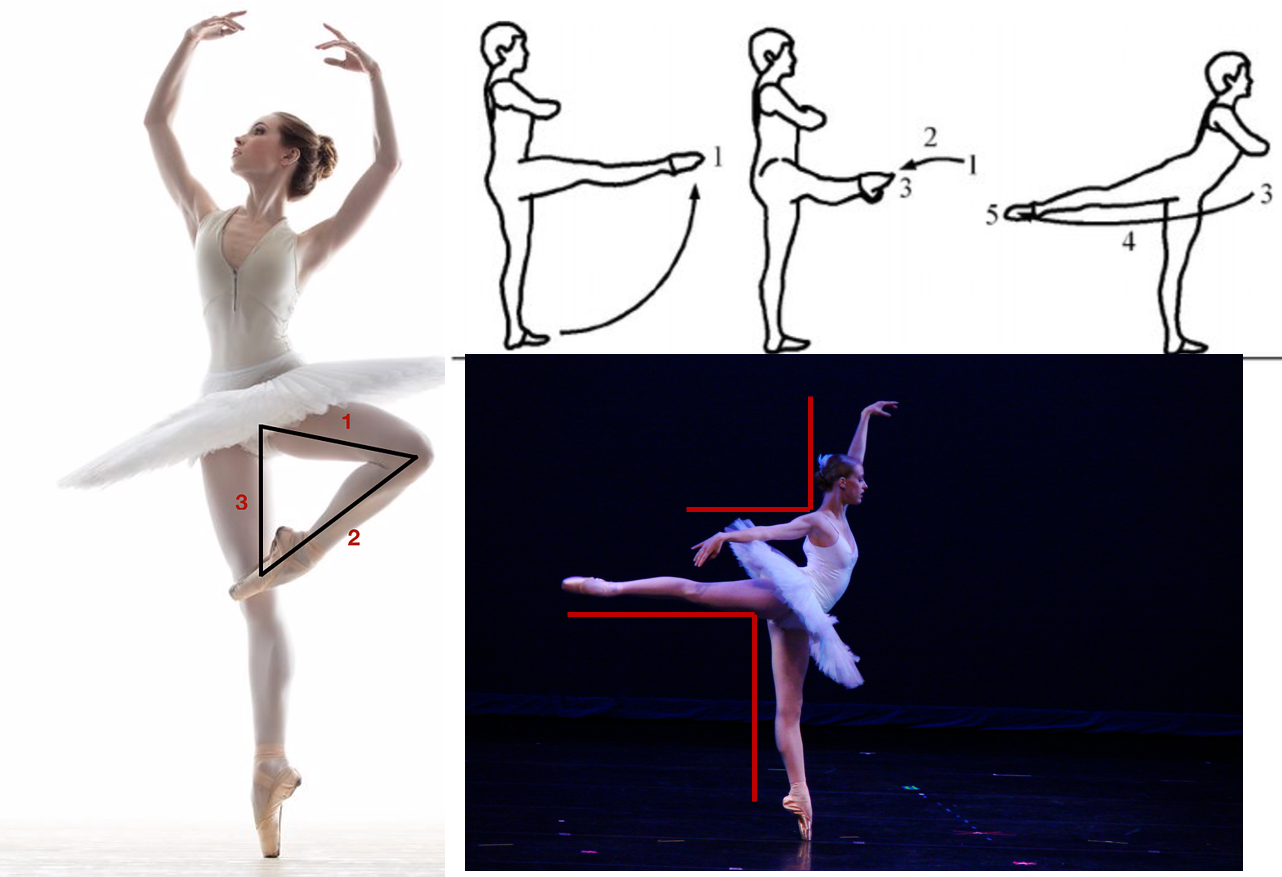
LEFT: Passé, the dancer forms an equilateral triangle with her legs. The dancers’ arms are in a circle above her head. TOP RIGHT: The movement of a grande rond de jambe in which the dancer elevates their legs 90 degrees in front then rotates it to make a semicircle. BOTTOM RIGHT: The dancer forms a right angle with her legs (arabesque) and her arms.
Physics
Long before I was solving physics equations, I intuitively learned about such concepts as potential and kinetic energy, center of mass, momentum, inertia, projectile motion, torque, and centripetal force.
Energy & Jumps: The concepts of potential and kinetic energy are important in ballet. Potential energy is energy that is “stored up”. Kinetic energy is energy of movement. This is very obvious in jumps. When the dancer pliés and bends their knees, they are gathering the energy needed to push off and jump. Good dance studios will have a wooden floor that has a slight “spring” to it, to help protect dancer’s joints
Turns: A dancers’ body needs to be carefully aligned to not wobble during a spin. The core muscles are very important, as that is where the dancer’s center of mass is.
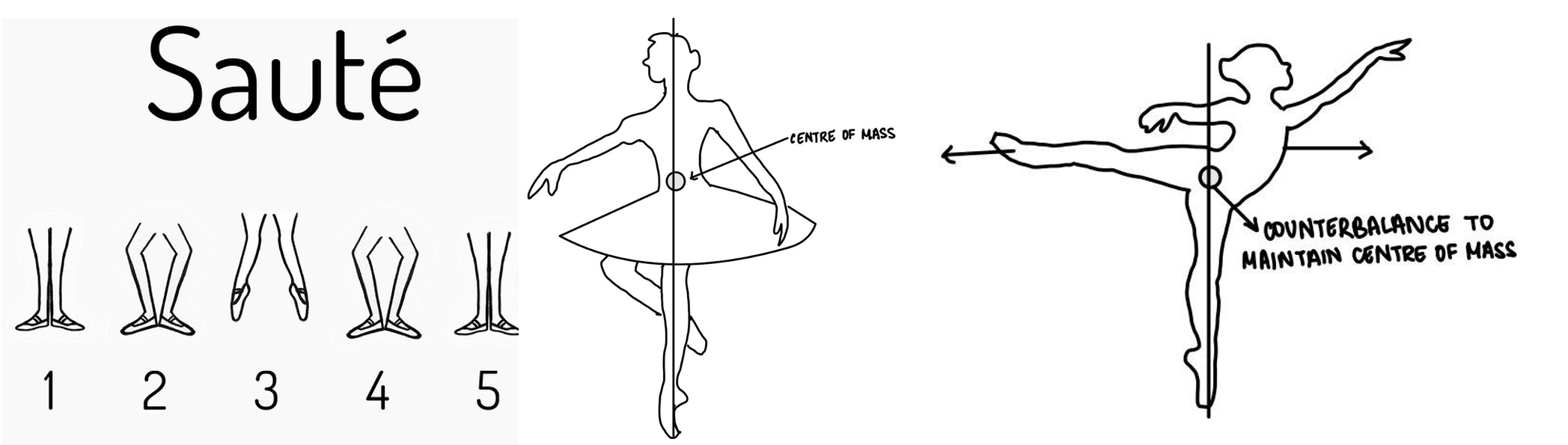
LEFT: Sauté is a small jump in ballet. The dancer bends their knees (potential energy #2) and then springs off to jump (kinetic energy #3). MIDDLE: Center of mass is an important concept in the mechanics of solids. It is the point from which mass is distributed in a solid object and is used to help balance. Strong core muscles are often needed to perform complex ballet moves, to maintain one’s balance. RIGHT: Arms are used to balance.
Friction: Dance floors and dance shoes are very important to minimize friction. Friction can make it hard to turn. Pointe shoes, in fact, have the ballet dancer balance on a very small box of their shoe. The entire weight of the body rests on their toe tips, minimizing contact with the floor.
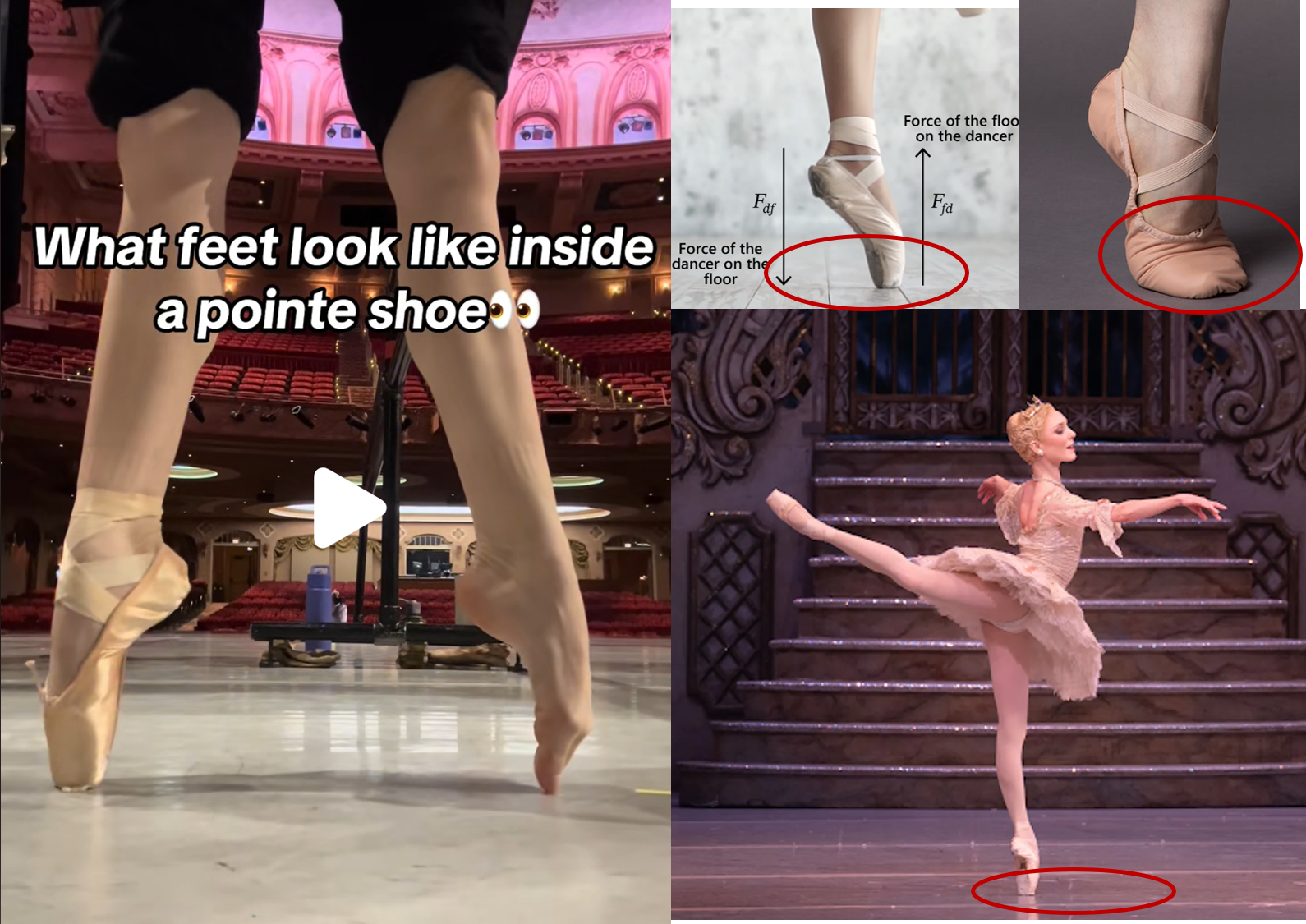
LEFT: What a foot looks like in a pointe shoe. Right TOP: Forces on a pointe shoe. The smaller surface area of the shoe box means less contact with the floor so the dancer can complete more revolutions then on a soft shoe. BOTTOM: The shoe must have proper friction and grip on the floor so the dancer does not slip.
Leaps: Projectile motion is classically taught by imagining one is throwing a baseball; the ball arcs forward, hits a peak height, and then falls. Gravity, velocity, and time influence the trajectory of the ball. In the grande allegro portion of ballet class, the dancer makes giant leaps across the room, usually gracefully running before leaping to obtain the initial velocity they need to lift off and gain momentum (their mass times their velocity).
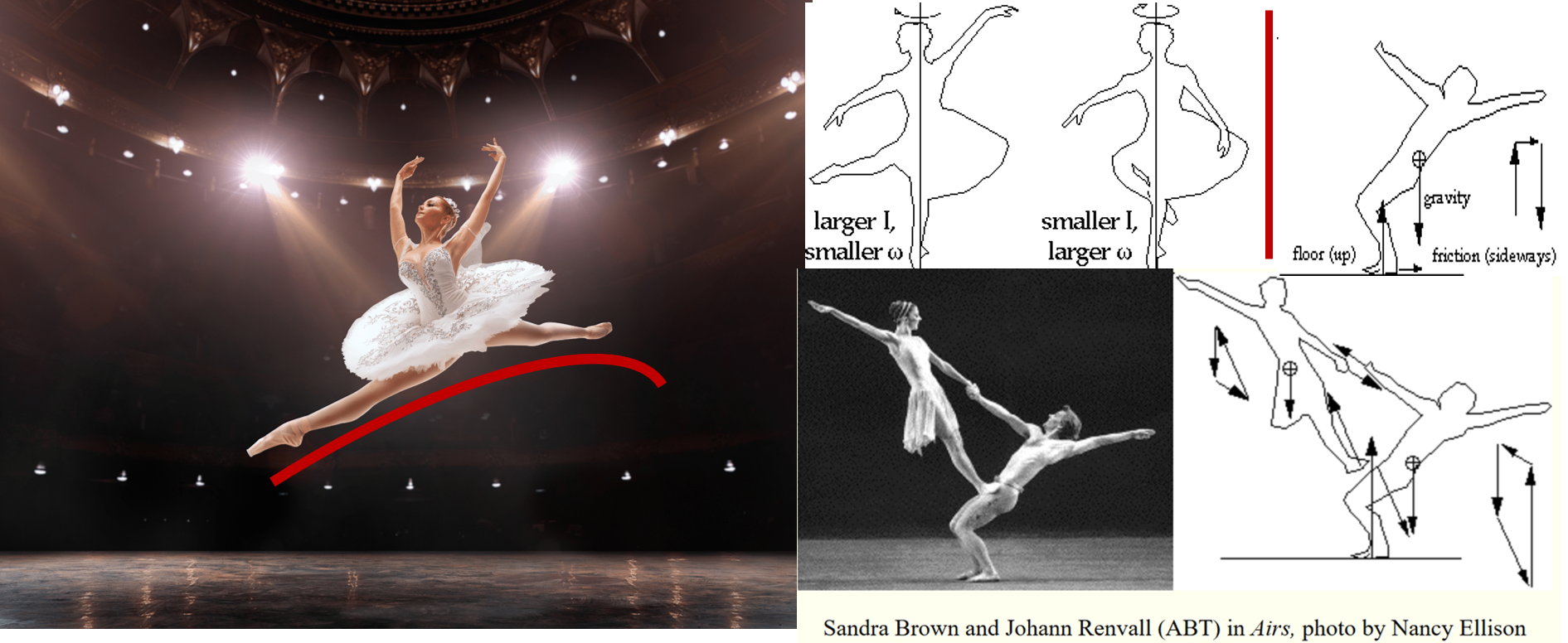
LEFT: A grande jeté where the dancer moves quickly then leaps forward across the floor, creating an arc with their body. TOP RIGHT: Angular momentum demonstrated in a turn; the dancer loses momentum if she extends her leg. BOTTOM RIGHT: An unusual balancing act made possible because all the forces are balanced (gravity, friction, the force from the floor, and each other’s bodies).
Persistence & Repetition
Long before I became and engineer, ballet class was teaching me to observe details. I learned how to subtly shift my body to execute movements in a safe manner that was also followed the choreographer’s intention. Often, we repeated combinations over and over again and received feedback and criticism. I also have “flat feet” and had to learn to do special exercises to improve the arch in my feet.
This is not unlike being an engineer. Often, I have a final goal but have to ask for and accept a lot of feedback from mentors and teammates. Sometimes, I’m doing something completely wrong and have to go back to the beginning trying again and learning. Sometimes, I have to practice and learn a new skill I’m deficient in.
Like ballet, I had to learn the basic moves in engineering…starting with computer, math, physics, biology, and chemistry principles and then building up to more complicated problems to solve. These projects are like dances which combine simple, basic movies into complex projects.
Ballet encapsulates a lot of aspects of my personality. It is creativity expressed within the confines of defined movements. Like when I do scientific work, I have to adhere to certain mathematical and physical limitations, I also adhere to these things during ballet. Ballet productions also involve narrative building and acting in character, something I am drawn to through my creative writing.
However, AI is coming for ballet. I’ll explore this and using ballet as a tool to recruit women to STEM in future posts!
I took ballet growing up also, and enjoyed this scientific reading of the art and discipline of ballet. My teacher was extremely strict, and extremely ordered. We had memorized classes, where every class followed the same routine (the advanced level rotated among 4 memorized classes), which is a bit unique I think. But it served a purpose you identify in the post: practicing the same movements over and over and over again to really master them.
You're inspiring me to practice at home. What's your setup? Do you have a portable barre, do you use a chair, etc.? Hardwood floor?
Fabulous!