


Anyone who has ever been on the academic job market will likely understand the experience 100s of rejections, week-long interviews, and the joy of crafting and tailoring multiple page long applications to be ghosted.
Yet, in my area, at least, academic jobs are seemingly less competitive than industry jobs. I’ve been rejected to both industry and academic jobs—HR tells me there were 500+ applicants for so and so industry job.
Given the extreme volume of applications, hiring often relies on networks, internal name dropping, and an extreme level of excellence and accomplishment. Since the number of faculty positions has remained virtually stagnated for decades, gaining a faculty job or even a postdoc requires more than just graduating from a doctorate program.
Being good is not good enough.
Prestige Chasers
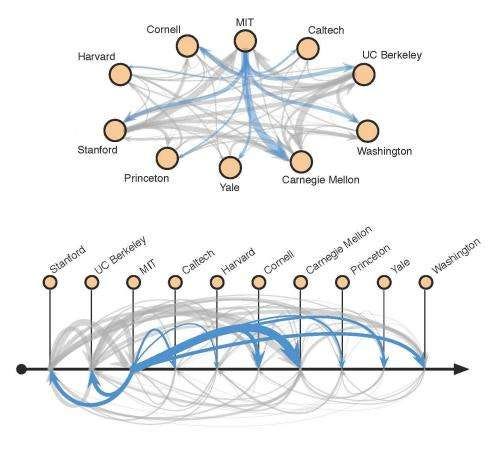
Top universities computer science faculty are hired from.
The academic job market has typically relied on precedence, custom, ambiguous standards, confidential decision making, informal networks, and “likability”. Historically, these ambiguous factors have disadvantaged women, people of color, and those with disabilities.
One of the most important factors in hiring tenure-track faculty is the never-ending chase for “prestige”. This includes not only lateral hiring of faculty from top institutions, but candidates who received their doctorate from elite R&D institutions. Notably, by 2015, 25% of American universities placed 71-86% of all tenure-track faculty. Top 10 units produced 1.6-3.0 times the faculty than the second 10 which produced 2.3-5.6 times more than the third ten (Clauset et al., 2015).
Furthermore, elite institutions have generally excluded those from working class backgrounds, often requiring a financial advantage to enter and are more likely to have lower populations of working-class folk. The “elite” factor can also facilitate informal networking, which can put women, people of color, those with disabilities, and working-class candidates at a disadvantage. Notably, in one 1984 study, black faculty members which received interviews, received them through networks, not a response to ads (Exum et al., 1984).
Legal Focus
Unlike in undergraduate admissions, there has been little legal focus on affirmative action in faculty hiring. In fact, the Supreme Court never tried a case like Bakke to prohibit affirmative action in promoting faculty diversity (Alger, 1999). According to Alger, justifications for increasing the diversity of faculty have been met with skepticism.
Common arguments are that faculty of color are 1) role models for students of color 2) can provide different prospectives, and 3) can contradict student stereotypes and assumptions, were rejected by the Supreme Court (Alger, 1999).
By the mid-1970s, universities also found ways to fend off affirmative action demands from the Departments of Labor, Health Education and Welfare (HEW), the Office of Civil Rights (OCR), and the Equal Employment Opportunity commission (Geiger, 2019). For example, when HEW ordered the hiring of a woman as the next Chinese historian at Harvard, a call from President Derek Bok to HEW secretary Caspar Weinberger ended the matter.
Other universities, such as Princeton, Duke, and UC Berkely created elaborate models based on past numbers of Ph.Ds. rewarded to argue that minority hiring pools were so small that they couldn’t possibly comply with affirmative action demands. Other common strategies that have been deployed to circumvent affirmative action in faculty hiring include continued use of white male networks in recruiting, lack of diversity on search committees, transmitting negativity during interviews, lack of clearly defined job descriptions in position descriptions, and limited advertising for positions (Blackwell, 1988).
Superstars
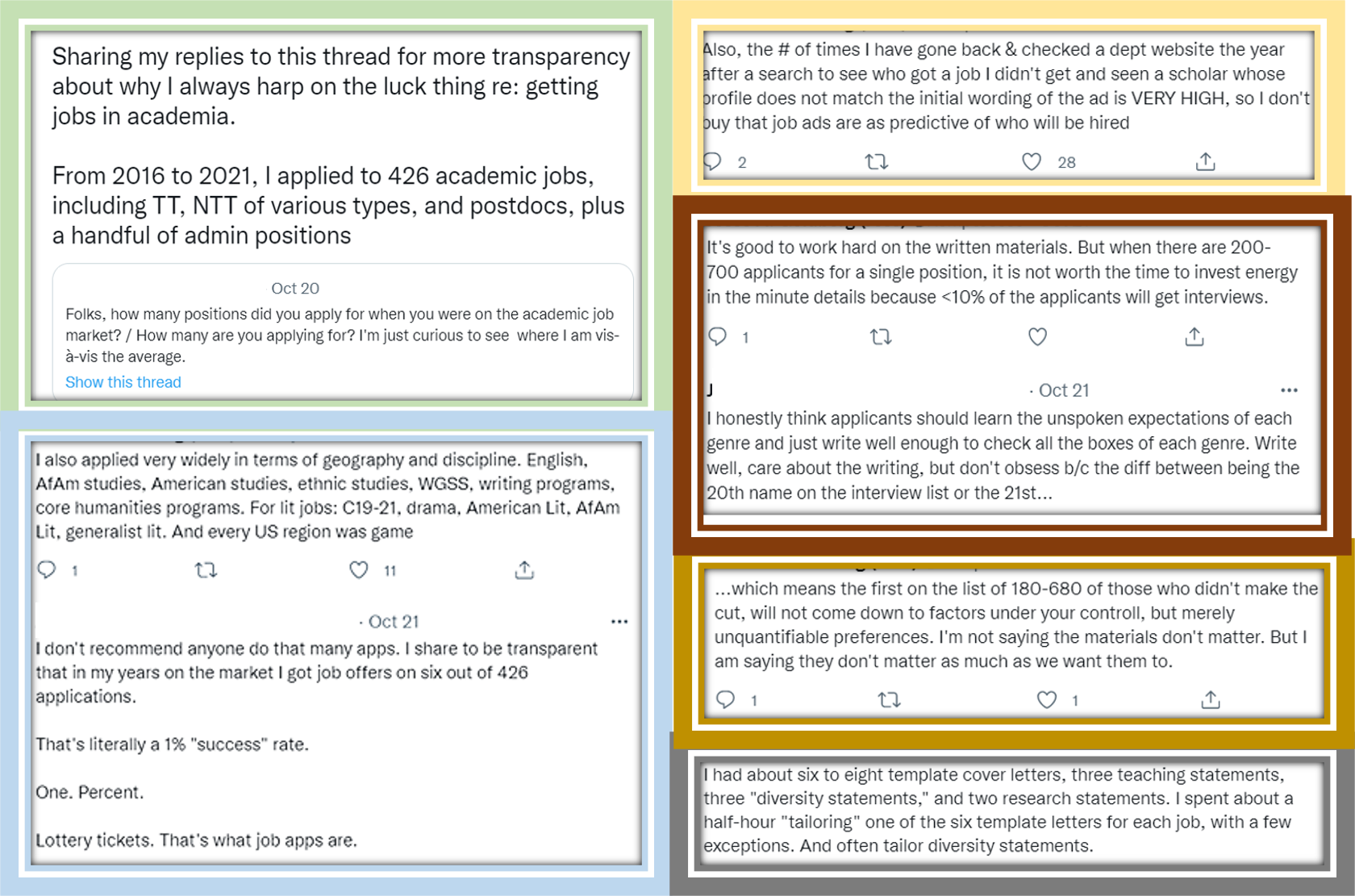
Twitter thread from Fall 2021. This poster graduated from an Ivy Leage university and applied to 426 academic jobs from 2016 to 2021 and only received 6 job offers. This thread is the most accurate and reflective I have seen of job hunting—the arbitrary standards, hundreds of candidates competing for 1 job, candidates who are hired that didn’t meet the position description, the tedium of submitting and balancing ‘tailoring’ v. application volume. Even if you have the perfect application, the chance you will get an interview is still low. It took me over 100 applications over a 2-year period to get a postdoc.
Ultimately, administrators who do hire more diverse candidates are most likely recruiting within a small pool of extraordinarily qualified candidates at the expense of the broader pool of early career faculty or recently graduated doctorates. This is similar to the unrealistically high expectations that were placed on female STEM scholars in the early to mid-20th century in order to encourage their attrition (Rossiter, 1995, 1982).
However, elite faculty are less likely to train female graduate students and postdocs. Elite faculty head so-called “feeder laboratories” which have a high number of postdocs who go onto faculty jobs (Sheltzer and Smith, 2014). Feeder laboratories were found to train 14% fewer female postdocs than nonfeeder laboratories (Sheltzer and Smith, 2014). Sheltzer and Smith argue that lower female employment in “feeder laboratories” is one aspect in the cumulative disadvantage which results in such low female employment as faculty members.
As Rossiter notes, prestigious postdoctoral programs favor the “cream of the crop” or a small percentage of women and those women who do get hired and earn tenure quickly (Rossiter, 2012). Such fellowship also require nominations from the institutions and can involve behind the scenes politicking among faculty members. Tus those who lack access to prestige institutions may be at a distinct disadvantage.
Genuine efforts to broaden the recruitment pool can increase opportunities for women in academia. Primarily, this requires aggressive recruitment that identifies candidates from high-producing minority doctoral institutions and recently graduated or all-but-dissertation doctoral students. Postdoctoral fellowships can be developed with the intent of hiring for faculty positions.
Case in point, the West Virginia Graduate College established a Minority Faculty Fellowship program to recruit minority faculty and dissertation-stage doctoral students (Gooden et al., 1994). In that program, the fellows interacted with current faculty and staff and brought new diversity to the university. This program was seen as a creative and imaginative way to recruit minority faculty members.
Other methods include subsidizing new faculty housing, instituting joint appointments, making sure all applications are read, and communicating genuineness in commitment (Blackwell, 1988; Light, 1994). This can include providing graduate students who aspire to faculty careers with opportunities to socialize with faculty and participate in programs for teaching and future faculty development (Austin, 2002). An inclusive hiring process will signal that the candidate’s work is an asset, that they are respected, and that they will receive a competitive employment package. The department will also signal that they are invested in the candidate’s development and success, and that the department is committed to a welcoming climate of diversity and excellence (Tuitt et al., 2007). Follow-up interviews on candidates who turned down offers could improve interviewing practices.
Tenure
Once a faculty member is hired, however, there are even more ambiguous standards to face to achieve tenure. While the Supreme Court has ruled that tenure decisions can be subject to judicial scrutiny for evidence of discrimination, the concepts of “merit”, “service”, “collegiately” can weigh heavily (Alger, 1999) (198). Basically, a candidate can be denied tenure if they are not considered “collegial” enough, regardless of their teaching or research output. “Collegiality” was a reason why Cornell Professor Donna Zahorik, received a negative evaluation. One commenter deemed her to be “to feminine” (i.e., unaggressive, unassuming, and not highly motivated for vigorous interpersonal competition) and suggested that was perhaps why she could not attract grad students (United States Court of Appeal, 1984). The AAUP maintains that “collegiality”, or one’s relations with peers, is just another strategy for discrimination (AAUW, 2004).
Though some women have initiated lawsuits based on the inappropriate application of “collegiality” in their tenure denial, collegiality is intrinsically tied with identity and thus another strategy to bar those with different identities form the white, heterosexual, male space.
A 1999 study examined African American, Asian Pacific American, Native American, and Latino faculty that were members of the Midwestern Higher Education Commission (MHEC) from 1993 to 1995 (Turner et al., 1999). African Americans were severely underrepresented in all states, Native Americans in seven of eight states, and Latinos in six. A major barrier for faculty was racial and ethnic bias, which resulted in isolation, lack of information on tenure and promotion, lack of support, gender bias, language barriers, lack of mentoring, tokenism, and a loss of cultural identity. Respondents reported being “passed over” in the tenure process or held to higher standards than whites. Asian Americans reported bias and a “chilly climate” despite not being underrepresented. A major reason offered by administrators for a lack of faculty hiring was yet again, a lack of qualified candidates, though Turner challenged this, since MHEC states had a diverse pool of Ph.Ds.
Revolving Door
Another strategy used to bar women and people of color from achieving tenure is the “revolving door” syndrome. These faculty are hired, kept on for five or six years, and then denied tenure. These conditions of additional teaching and service loads, makes it more difficult for them to meet the inflexible research and publication expectations of the University. Those who do publish quite a bit, were then often penalized for not publishing in “prestigious” places, regardless of the quality of their research or writing.
With the advent of social media and a twenty-four-hour news cycle, tenure denials have the potential to go public quickly. Faculty of color have begun sharing tenure denial and injustice more openly (Zahneis, 2021 ; Mochkofsky, 2021). With no way to track tenure denials nationally, the process is still shrouded in mystery and thus subject to discrimination. Some have pursued legal suits against discrimination. These lawsuits were largely unsuccessful in instituting concrete institutional or legal change, though they had the benefit of raising public awareness of these issues.
Unfortunately, the tenure process is still beset with political and racial biases. The denial of tenure to Nikole Hannah-Jones by the University of North Carolina at Chapel Hill epitomizes the politization of the tenure process. Hannah-Jones who had won a Pulitzer Prize and McArthur Foundation fellowship, was considered more than qualified to earn tenure (Ellis, 2021). However, her work studying systemic racism in the U.S. was considered to be the unofficial “reason” for this denial (Weineck, 2021). Without legal accountability, tenure denial cases will become more “accepted” in the highly partisan political landscape of the 21st century.
Conclusion
More equitable hiring requires dismantling the blinders of “meritocracy”. The so-called “meritocracy” of academia, instead, becomes a convenient argument against affirmative action, until it becomes too threatening. Special efforts to retain URM faculty may be ignored because of a fear of “undermining” this meritocracy. However, “Merit” becomes a malleable, ever-shifting standard. Often, these doctorates get punted to lower paying contingent (adjunct) work where the pay is low. Indeed, women and people of color are overrepresented in adjunct positions.
Welcome, and thanks for signing up! Please consider following me on my social media platforms:
References
AAUW, 2004. Tenure Denied: Cases of Sex Discrimination in Academia. Washington D.C.
Alger, J., 1999. When Color-Blind is Color-Bland: Ensuring Faculty Diversity in Higher Education. Stan. L. Pol’y Rev 10, 191–204.
Allen, W.R., Epps, E.G., Guillory, E.A., Suh, S.A., Bonous-hammarth, M., Stassen, M.L.A., 2002. Outsiders Within: Race, Gender, and Faculty Status in U.S. Higher Education, in: Smith, W.A., Altbach, P.G., Lomotey, K. (Eds.), The Racial Crisis in American Higher Education. State University of New York Press, Albany, pp. 189–220.
Austin, A.E., 2002. Preparing the Next Generation of Faculty. J. Higher Educ. 73, 94–122. https://doi.org/10.1080/00221546.2002.11777132
Blackwell, J.E., 1988. Faculty Issues: The Impact on Minorities. Rev. High. Educ. 11, 417–434. https://doi.org/https://doi.org/10.1353/rhe.1988.0013
Clauset, A., Arbesman, S., Larremore, D.B., 2015. Systematic inequality and hierarchy in faculty hiring networks. Sci Adv 1–6.
Delgado-Romero, E.A., Manlove, A.N., Manlove, J.D., Hernandez, C.A., 2007. Controversial Issues in the Recruitment and Retention of Latino/a Faculty. J. Hispanic High. Educ. 6, 34–51. https://doi.org/10.1177/1538192706294903
Ellis, L., 2021. Behind Nikole Hannah-Jones’s Tenure Case. Chron. High. Educ.
Exum, W.H., Menges, R.J., Watkins, B., Berglund, P., 1984. Making it to the Top, Women and Minority Faculty in the Academic Labor Market. Am. Behav. Sci. 27, 301–324.
Geiger, R.L., 2019. Surviving the Seventies, in: American Higher Education Since World War II. Princeton University Press, pp. 217–265.
Gooden, J.S., Leary, P.A., Childress, R.B., 1994. Initiating minorities into the professoriate: One school’s model. Innov. High. Educ. 18, 243–253. https://doi.org/10.1007/BF01191047
Kennelly, I., Misra, J., Karides, M., 1999. The Historical Context of Gender, Race, & Class in the Academic Labor Market. Race, Gend. Cl. 6, 125–155.
Light, P., 1994. “Not like Us”: Removing the Barriers to Recruiting Minority Faculty. J. Policy Anal. Manag. 13, 164–180.
Mochkofsky, G., 2021. Why Lorgia García Peña Was Denied Tenure at Harvard. New Yorker 1–15.
Rossiter, M.W., 2012. Women Scientists in America: Forging a New World since 1972. The Johns Hopkins University Press, Baltimore.
Rossiter, M.W., 1995. Women Scientists in America: Before Affirmative Action 1940-1972. The Johns Hopkins University Press, Baltimore and London.
Rossiter, M.W., 1982. Women Scientists in America: Struggles and Strategies to 1940. The Johns Hopkins University Press, Baltimore and London.
Samson, F.L., 2013. Multiple group threat and malleable white attitudes towards academic merit. Du Bois Rev. 10, 233–260. https://doi.org/10.1017/S1742058X1300012X
Sheltzer, J.M., Smith, J.C., 2014. Elite male faculty in the life sciences employ fewer women. Proc. Natl. Acad. Sci. U. S. A. 111, 10107–10112. https://doi.org/10.1073/pnas.1403334111
Tuitt, F.A., Sagaria, M.A.D., Turner, C.S.V., 2007. Signals and Strategies in Hiring Faculty of Color, in: Smart, J.C. (Ed.), HIGHER EDUCATION: Handbook of Theory and Research Volume XXII. Springer, pp. 497–535. https://doi.org/10.1177/000271622310700120
Turner, C.S.V., Myers, S.L., Creswell, J.W., 1999. Exploring underrepresentation the case of faculty of color in the midwest. J. Higher Educ. 70, 27–59. https://doi.org/10.1080/00221546.1999.11780753
United States Court of Appeal, S.C., 1984. Zahorik v. Cornell [WWW Document]. Casemine. URL https://www.casemine.com/judgement/us/5914c358add7b049347c59eb (accessed 6.5.23).
Weineck, S.-M., 2021. The Tenure Denial of Nikole Hannah-Jones Is Craven and Dangerous. Chron. High. Educ.
Zahneis, M., 2021. When Tenure Denials Go Public. Chron. High. Educ.