
Leaning into Scarcity Mindset
Fearmongering singledom was encapsulated in an infamous letter. And I read "Lean In" so you don't have to.


1956 ad glamorizing heterosexual marriage as the American Dream.
As an engineering major in the 2010s, I thought that society was past the “MRS degree”. I had been encouraged to major in engineering, go to graduate school, and make scientific discoveries. Growing up, nobody ever “grilled” me on dating/marriage/child plans. In fact, it was heavily emphasized that I should finish all my schooling before getting married or having children, common advice directed towards a lot of Millennial women (I later found out that conservative pundits have coined this as the “success sequence”— a supposed path to financial stability and a way to control women’s sexuality). Despite attending a secular college, I was surprised to hear pro-marriage messaging. The first time I encountered this was in a University orientation, which boasted that they had high marriage rates among alumni.
Messages were sometimes subtle, sometimes overt. Messaging about fertility (as evidenced by ads begging for my eggs). The costs of childcare compared to my future salary. The two-body problem (I was considering academia at this point). And finally, the importance of finding a Good Partner. As an undergrad, I attended a woman in STEM event led by Debora Spar, author of Wonder Women: Sex, Power and the Quest for Perfection. She lamented that even with an amazing partner, there are days that are just “crazy” (she recalled tending to an injured chipmunk before she had to give a major presentation). Spar was a Sheryl Sandberg-type “power woman” who “had it all”. But she argued, to us young, naive girls, this hinged on who you married.
My main reason to be in college was to get a degree, not find a husband. Despite this intention, social and cultural messaging implied that finding a husband was hard work, and that you should start looking now even if you didn’t immediately plan to marry. Otherwise, you would be single and potentially foregoing children, financial stability, property ownership, or even love. College women seem to be particularly targeted for this narrative. Perhaps, it is because well-educated women are more likely to identify as feminists? Or that, historically, until the past few decades, they were less likely to marry?
Blockbusters, Girl Bosses, and ‘Lean In‘
The years 2013-2014 ushered in several “blockbuster feminist” books including Sheryl Sandberg’s Lean In (2013) and Roxane Gay’s Bad Feminist (2014). Feminism seemed to be having a moment in the early to mid-2010s. Disconcertingly, however, many of these feminist books were centered on marriage and dating men, and the supposedly soul-crushing loneliness of singlehood. They were less empowering than one would imagine. Some promoted the girlboss narrative, a term which gained popularity with the publication of the 2014 book #GIRLBOSS by Sophia Amoruso (CEO of a company unbelievably called ‘Nasty Gal’**).
The title Lean In might imply that women should band together to fight the patriarchy and enact change. One could only dream. Instead, Lean In revolves around Sandberg’s observations that women ascending the so-called corporate ladder often “lean out” of their career in anticipation of having children. Sandberg argues that individual women should not “lean out” until the times comes (i.e., the baby is actually born). Based on this faulty premise, she argues women don’t pursue career opportunities because they know they’ll have to pull back at some point to have kids. To “lean in”, women presumably just need to adopt male-coded workplace behaviors; bluntly asking for raises, promotions, opportunities, or feedback. She patronizingly warns against “tiara” syndrome, that women just expect if they work hard the promotion will come. She notes how few and far between advancement is:
There’s no question that the world moves faster today. This means that grabbing opportunities is more important than ever. And I don’t have to tell you that you are entering a struggling economy. So along with all the excitement, most of you will also feel some uncertainty and fear (6)
She hardly explores how factors like sexism, racism, ableism, double standards or harassment affect women in the workplaces. Or that the places where she worked (Google, Facebook) have toxic work environments. She speciously suggests that as women rise to the top, they will resolve these systemic issues (a new memoir suggests otherwise). Sandberg herself seems to have had a charmed rise in the business world, mentored by the one and only Larry Summers, who famously declared that women biologically have less intrinsic aptitude for STEM. Sandberg’s narrative is the one that women in STEM are often fed: adopt male traits, conform to male culture and be rewarded.
Disappointingly, much of the book focuses on shallow dating advice. Sandberg’s premise is that, for women, marriage is their most important career decision. This is dumbfounding and can instill a spiral of self-doubt about one’s actual qualifications. Not the college I went to? Not my major? Not my grades? Not my publication history? Not internships? Not my career history? What if I don’t marry? Am I penalized for this? Does NOT getting married negatively impact me? While, yes, women are less likely to benefit from heterosexual marriage than men, Sandberg makes a troubling assertion by equating marriage with women’s career success.
In college, Sandberg herself was “encouraged’ by her parents to find a husband. She details that she spent of her time in college dating with the intent of finding a husband. A year out of college, she married, and then a year later divorced and was not married for 10 years, during which she steadily rose in the tech world. An especially controversial paragraph in Lean In encourages women to date “everyone”:
When looking for a life partner, my advice to women is date all of them: the bad boys, the cool boys, the commitment-phobic boys, the crazy boys. But do not marry them. The things that make the bad boys sexy do not make them good husbands. When it comes time to settle down, find someone who wants an equal partner (p 115)
This “advice” could be interpreted in many ways. This could equate “dating” to an “educational opportunity”. Anti-feminists could interpret this as encouraging women to “exploit” men for short-term fun and sexual gain. Others might perceive this as encouraging woman to go against their gut instinct about someone, and to date “bad boys” that could potentially traumatize them. Her book also offers no advice on how to “find” this mythical partner, what traits this mythical partner “should” have, and that 50/50 divisions of household labor and childcare can easily be planned. Her naive advice is “If you want a fifty-fifty partnership, establish that pattern at the outset.” (116). She does not follow up on this statement. Lean In, disappointingly focuses on romantic relationships as the main hindrance to a women’s career success. She even argues for dating men who are not quite right for you deep down because it’ll “teach you”. This statement implies that women’s primary social education comes from romantic relationships.
The term “Lean In” took off but often emphasized shallow dating and marriage advice. Sandberg even pushed the message that women were “turned on” by men doing chores, circulated by Business Insider (“SHERYL SANDBERG: Men who do housework have more sex”). Cosmopolitan even ran an article about “Finding a Man Who “Leans Ins”. Though Sandberg’s shallow takes on feminism were heavily critiqued including by the National Organization for Women, fearmongering was in full force.
In 2015, The Guardian ran an article about the so-called “mating” gap, in which highly educated, ambitious, 30-something single women are supposedly desperately searching for a partner before their fertility ends, which was encapsulated in Marcia C. Inhorn’s Motherhood on Ice: The Mating Gap and Why Women Freeze Their Eggs. The book focuses on heterosexual relationships as the main barriers to women’s access to motherhood and promotes egg freezing as the solution to “equalize fertility”, though egg freezing is expensive and has a low chance of resulting in live birth. Unsurprisingly, many companies including Facebook jumped on the “egg freezing” bandwagon, instead of providing better work environments for women.
Such books suggest that romance is a game of musical chairs and there are only so many chairs until you are left standing, alone. That partners are a finite resource. That your 20s and 30s should be completely centered on finding a suitable partner and taking advantage of your fertility. They rarely focus on other barriers (lack of free childcare, astronomical health care costs, lack of maternity and paternity leaves ect) to career success, fertility, and motherhood. They propose unrealistic and individual solutions to solve these problems. They also fail to present singlehood in a positive light and center heterosexual marriage.
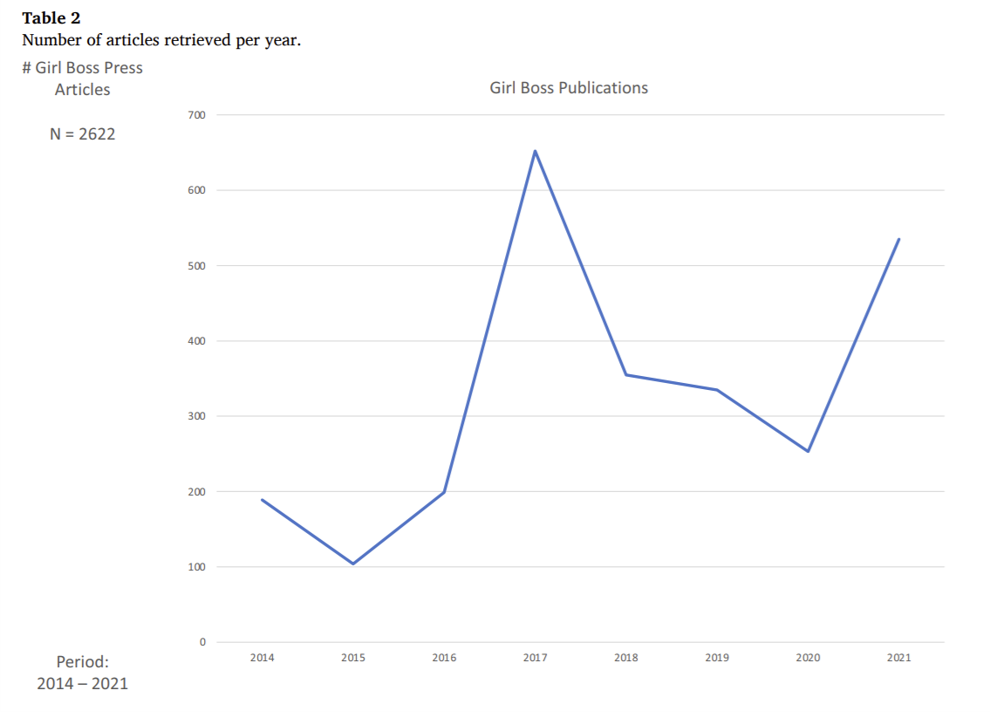
Byrne and Giuliani (2025), report the number of “girlboss” articles from 2014-2021.
This fearmongering can result in unhappy partnerships. A 2013 study including undergraduates looking for relationships noted that: “Those with stronger fears about being single are willing to settle for less in their relationships,” says Spielmann. “Sometimes they stay in relationships they aren’t happy in, and sometimes they want to date people who aren’t very good for them.
This narrative also fails to consider polyamory, shorter term relationships, or divorce. Yet it’s insidious. Theres’s a type of scarcity narrative being pushed onto us college women that I did not see my male peers having to contend with.
The Letter
In 2013, Princeton alumni Susan Patton ’77 offered “advice” to Princeton’s female undergraduates. In a 2013 letter published by The Daily Princetonian Patton wrote:
“Here’s what nobody is telling you: Find a husband on campus before you graduate. ... You will never again be surrounded by this concentration of men who are worthy of you […] College is the best place to look for your mate. It is an environment teeming with like-minded, age-appropriate single men with whom you already share many things […] Smart women can’t (shouldn’t) marry men who aren’t at least their intellectual equal. As Princeton women, we have almost priced ourselves out of the market. Simply put, there is a very limited population of men who are as smart or smarter than we are. And I say again—you will never again be surrounded by this concentration of men who are worthy of”
This letter set off a firestorm and “inspired” Patton to write a book. For the next year, multiple articles ran about this topic. Patton follows up her “advice”:
Think about it: If you spend the first 10 years out of college focused entirely on building your career, when you finally get around to looking for a husband you'll be in your 30s, competing with women in their 20s. That's not a competition in which you're likely to fare well. If you want to have children, your biological clock will be ticking loud enough to ward off any potential suitors. Don't let it get to that point. […] You should be spending far more time planning for your husband than for your career—and you should start doing so much sooner than you think. This is especially the case if you are a woman with exceptionally good academic credentials, aiming for corporate stardom.
As woman embarking on graduate school this might seem like alarming advice. Fortunately, I was well-versed in feminism and largely dismissed this advice as right-wing conservative fear mongering. However, some women took this seriously.
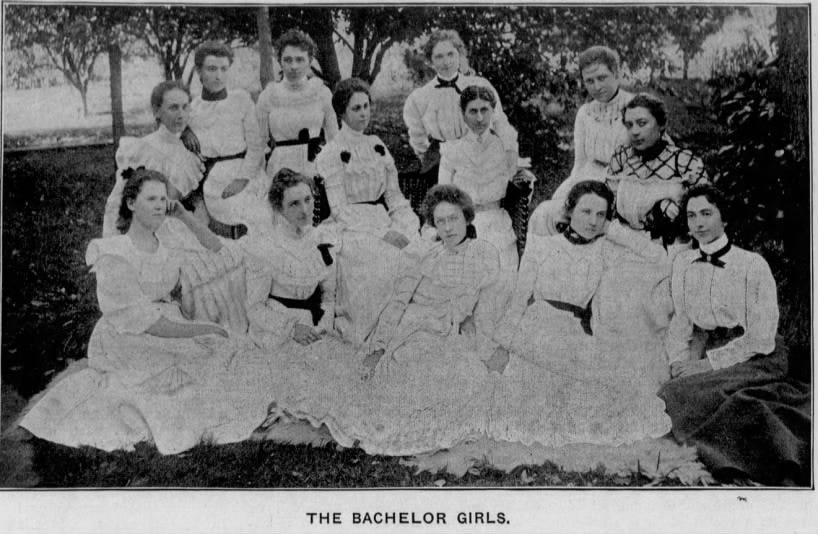
1900s “Bachelor Girls Club” in Kansas overcoming the negative stereotype of the “old maid”.
Most Highly Educated Women Got Married
College women have been marrying at steady rates (~70%) for decades while the rate for women without degrees has continued to drop. Women with PhDs are even more likely to get married. In fact, women college graduates before the 1970s (the era of the so-called MRS degree when female students faced significant pressure to find a husband in college) were more likely to remain single than today.
Fearmongering attempts to provide “proof” that a woman should find a partner before 30. This operates on a scarcity mindset, prays on insecurities, and reduces romantic companionship to a mere economic proposition. It also implies that reproduction should be the central focus in career planning and places the burden on the women rather than unfair social structures. In fact, some 2010s women took this “advice” seriously and focused on “husband hunting” in college. Women who followed Sandberg’s advice, found it unrealistic about the realities of motherhood and corporate workplace culture.
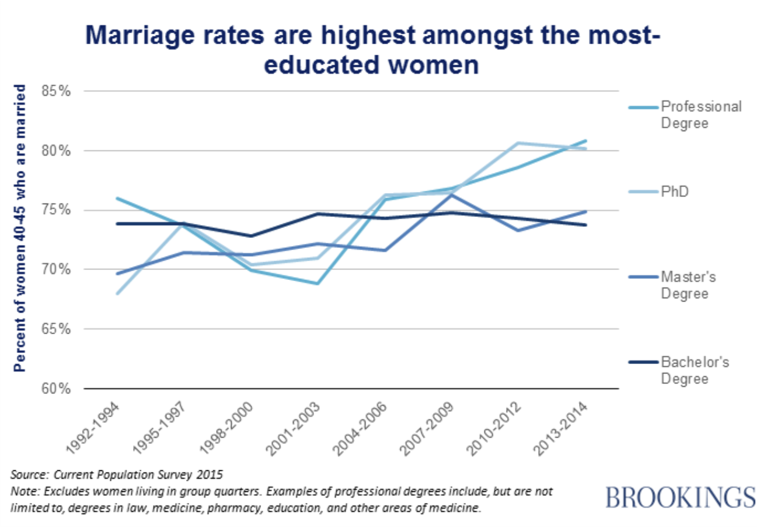
Marriage rates in the United States among education levels.
Conclusion: Stigma & Singledom
Women are conditioned to believe/accept that there is a scarcity of good partners. These “scary campfire stories” create a sense of urgency and pressure for women to prioritize romantic relationships. There is stigma to being single. Social scientist Bella dePaula writes that:
In 1992, I started researching single life because the representations of single people I was seeing in the media just weren't matching up to my experience. The common message they were sending was that there was something wrong with you if you're single, you're unhappy and lonely, and others should feel sorry for you. Personally, this was not at all how I felt, and I later learned through my own research and reading the work of other scholars, that single people on average are more connected to more different people than married people. I like to say that married people have "the one", but single people have "the ones."
An article called “Why Being Single in College is the Best” writes
It is now 2018, and being single still warrants comments like “oh, don’t worry, you’ll find someone,” or “maybe you should try Tinder,” or “oh, why are you still single?” as if it needs some sort of explanation. Well, I’m here to tell you that being single in college is the best.
A 2017 article authored by a woman around my age, laments wasting time in college worrying about finding a suitable partner. She looks back appalled that she would ever even marry one of the men.
But, perhaps most importantly, I think what women today are realizing and what Patton's way of thinking underestimates, is how enriching it is, as a woman, to live on your own and experience the start of your career before getting married. As a friend once confided in me: “Although I’m generally independent, I really did expect I was going to get married out of college. But I’m happy it didn’t happen. I’m learning a lot on my own.” For me, it was the experience of living the single life post-graduation that rewired my brain to understand who I was and what I needed in a relationship. The fact that I didn’t meet my one-and-only in college turned out to be a great fortune. My college years and early career gave me the building blocks to become me, which ironically—yet very necessarily—led me to him.
Yes, I do find, great satisfaction in being completely financially independent, and managing my time how I choose. I will continue this series by looking at tech’s role in fearmongering singledom.
**When I was in middle school, my mild-mannered cardigan-wearing grandmother gifted me ‘Nasty Gal’ lip gloss for Christmas based on a recommendation from a saleswoman. My mom saw the package and her eyes bugged, “who bought you ‘Nasty Gal’ lip gloss?”
After two unfortunate marriages, I've been single for 25 years. My money is under control. I am not in debt other than a mortgage. I'm an elder Boomer, so I've had some historical edges.
I love how you threaded so many texts through this piece — ones you disagree with, ones you agree with, others that provide context. That’s my favorite kind of read!